Research
Computational methods for spatial biology and multimodal integration
I develop computational approaches to characterize cell state and decode its drivers. By placing otherwise incompatible assays into a shared anatomical-statistical space, my models describe cells and their neighborhoods in intact tissue, learn what drives cellular decisions, and design experiments that close the loop from data to action.
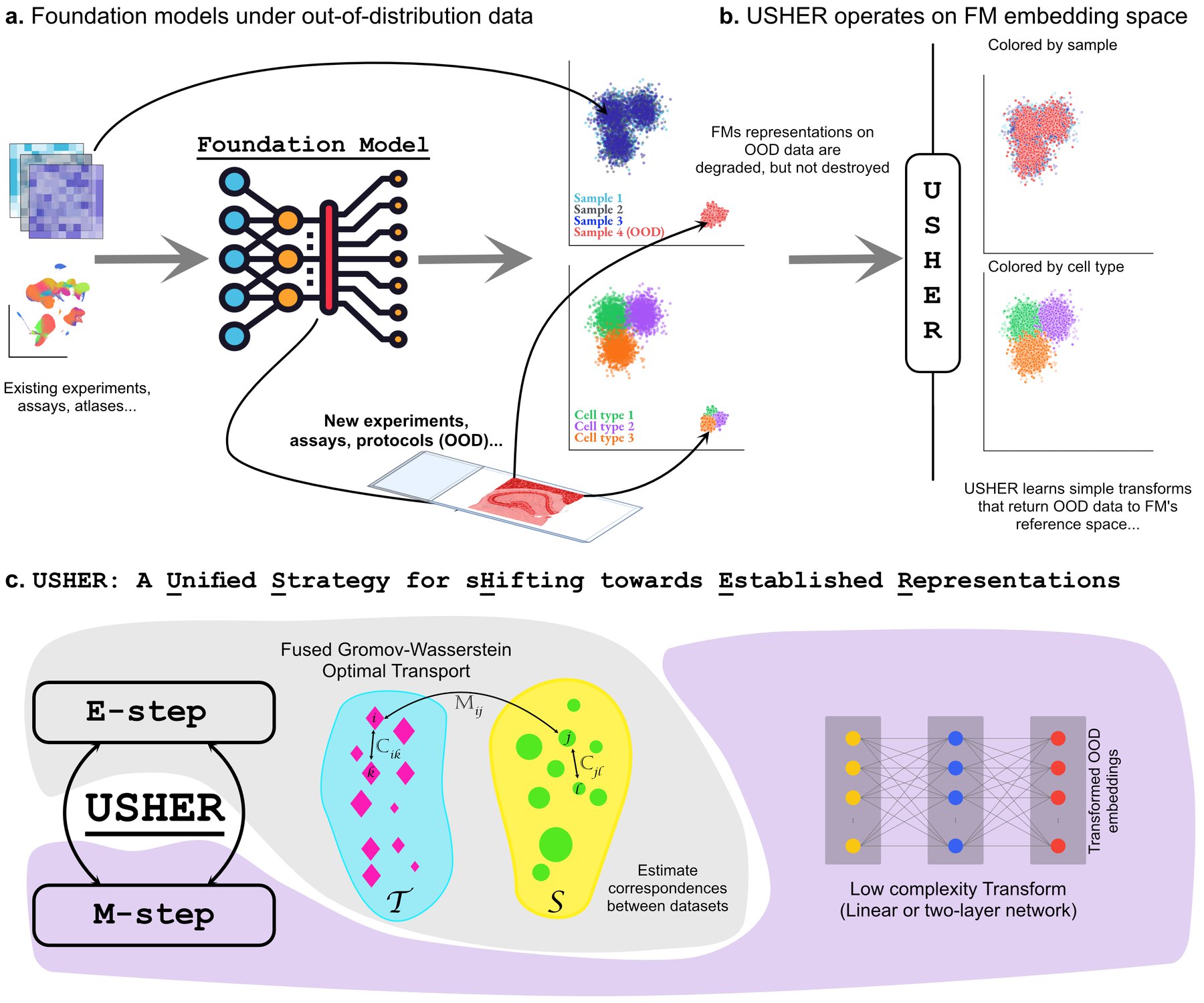
USHER
Adapting foundation models to new data without retraining.
Foundation-model embeddings drift under shifts in protocol, instrument, or imaging, and retraining is costly. USHER maps new data back into the model's established embedding space with fused Gromov-Wasserstein optimal transport and a low-complexity transform, leaving the model's weights untouched.
It removes artifactual variation while preserving biological structure, across sequencing and imaging data.
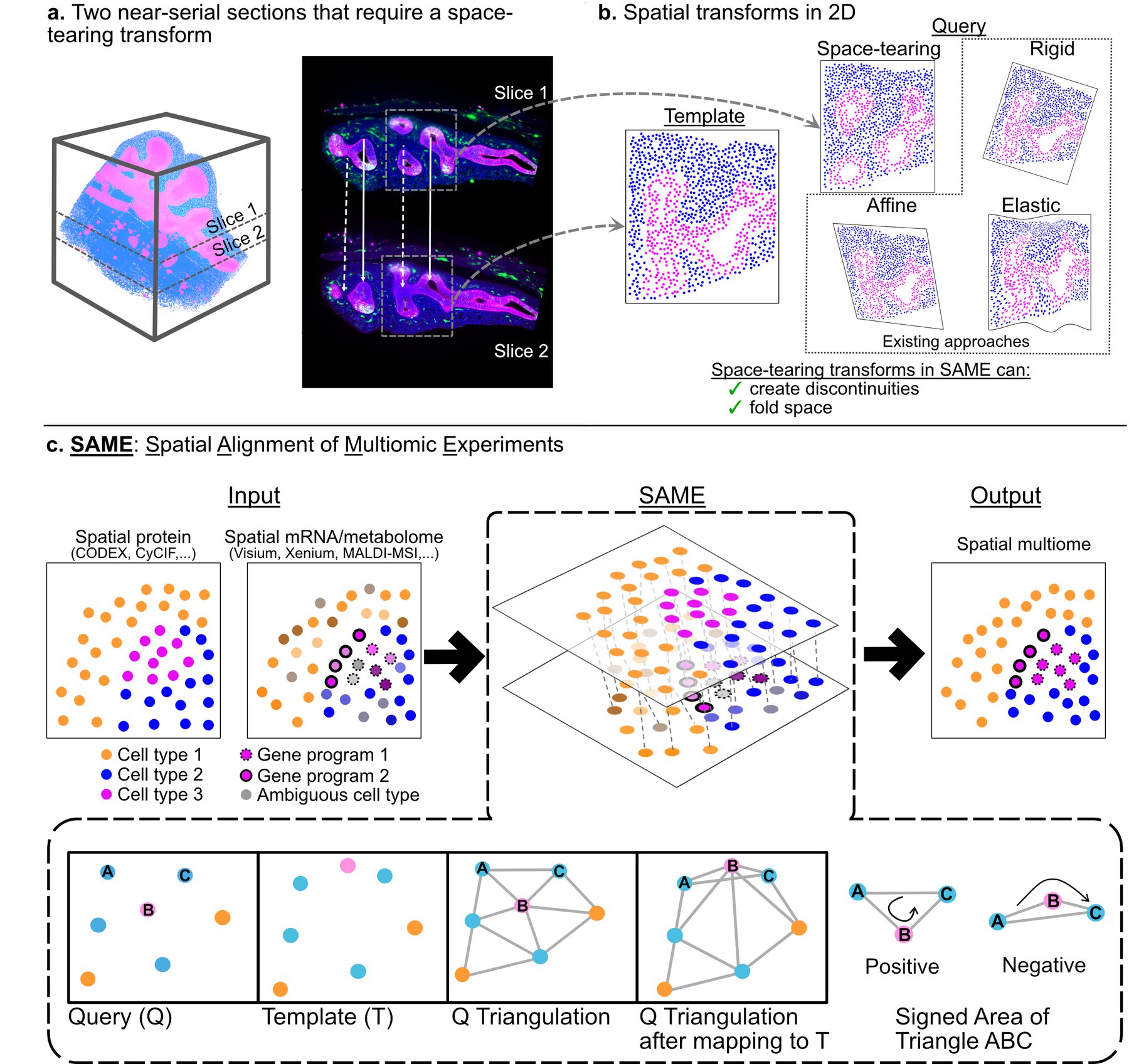
SAME
Aligning serial tissue sections measured with different assays.
Spatial assays for proteins, transcripts, and metabolites are usually run on neighboring tissue sections, and existing alignment methods break down when those sections tear, fold, or change anatomically. SAME introduces space-tearing transforms, which allow controlled local breaks during alignment, and uses integer linear programming to maximize cell-type matches across modalities. It improves cell-type alignment accuracy by 20% over existing methods.
In tongue tissue and lung adenocarcinoma, integrating protein and RNA revealed immune subpopulations that neither modality found alone. Integrating protein and metabolite data localized mevalonic acid upregulation to tumor-macrophage niches.
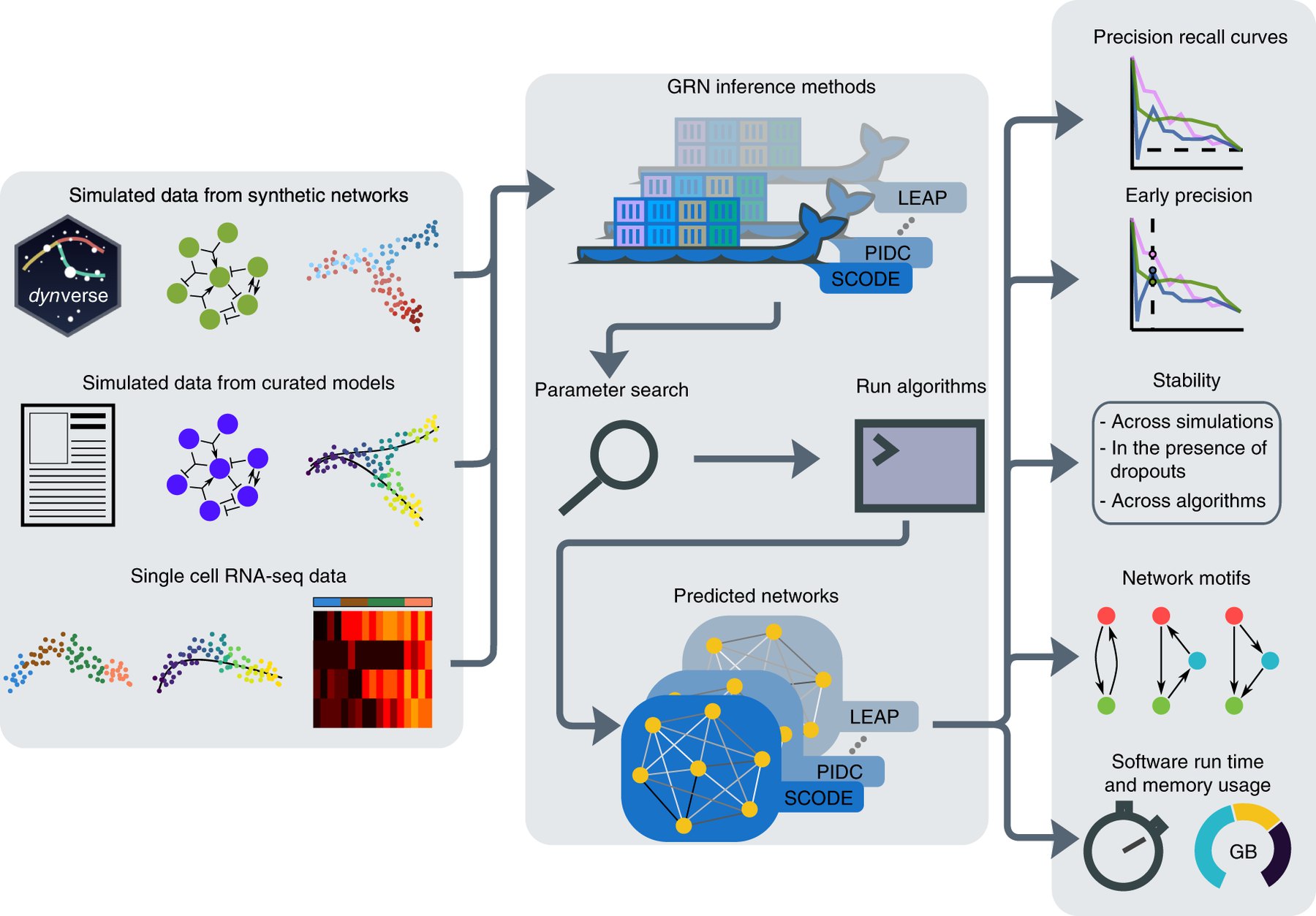
BEELINE
A community benchmark for gene regulatory network inference.
BEELINE evaluates methods that infer regulatory networks from single-cell data on synthetic networks, curated models, and experimental data, with reproducible, containerized pipelines and curated gold standards.
It has been cited in over 1,000 subsequent works and is now a standard for benchmarking regulatory network inference.
Other work
Data Science Competitions
I'm always happy to talk with potential collaborators and students. Get in touch.